
About the client
The client is a health insurance company that’s been around for over 20 years. They focus on serving families. The identity of the client is protected for privacy purposes.
Summary of what I did
- Digital strategy for 6-figure advertising budgets
- Analytics via Google Tag Manager and Google Analytics
- Google Ads campaigns
- Microsoft Ads campaigns
- Meta Ads campaigns
- Video campaigns
- Multilingual campaigns
- eROAS modeling
- Data aggregation for MMM (media mix modeling)
Highlights
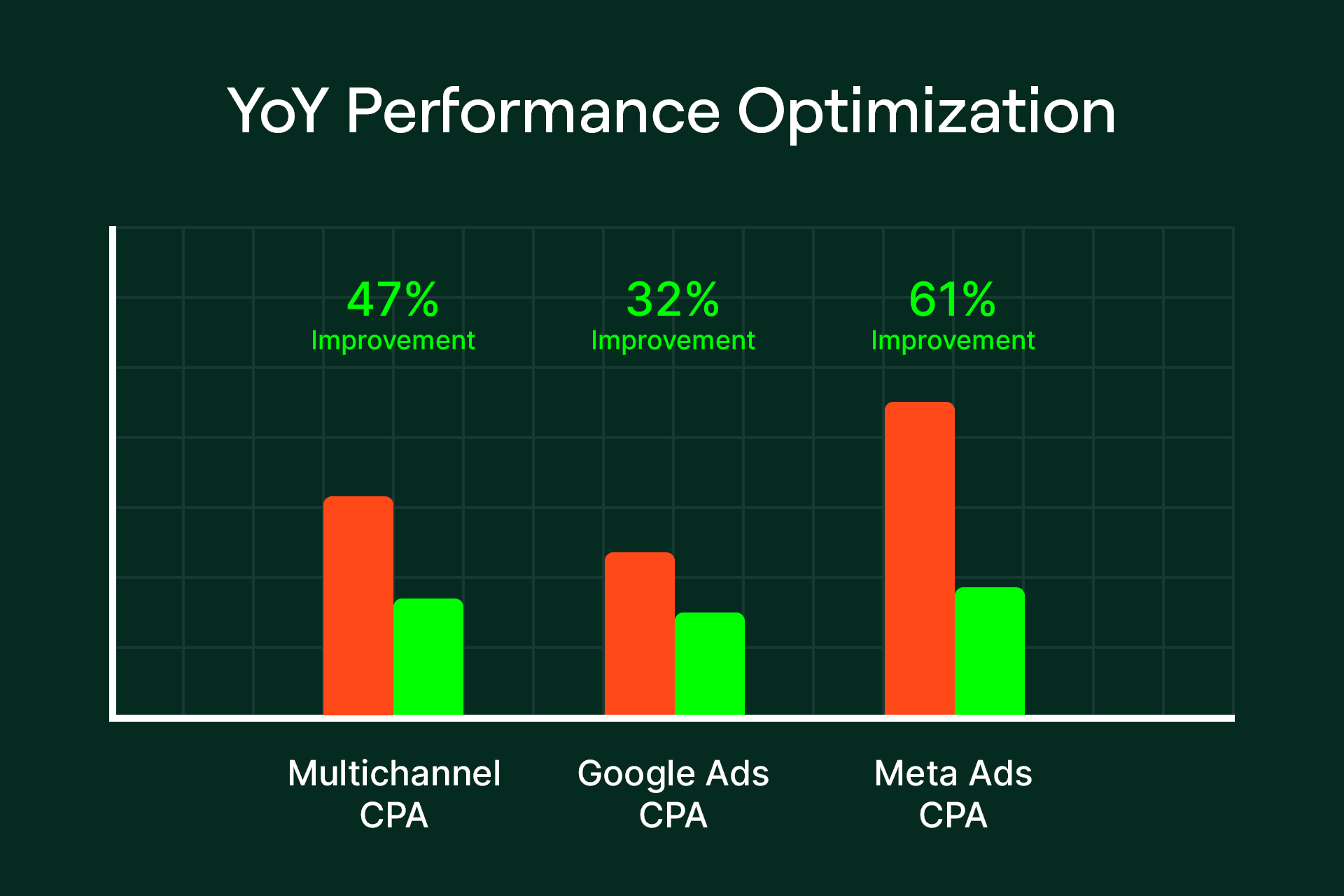
- 47% YoY improvement in Multichannel CPA
- 32% YoY improvement in Google Ads CPA
- 61% YoY improvement in Meta Ads CPA
The problem
This health insurance company has been around for decades and previously focused their marketing efforts on non-digital channels including TV, radio, billboards, bus wraps, and popup stations. It was time to catch up with the digital age and shift some of their marketing budget to digital channels.
Although this organization had many internal marketing roles, they didn’t have the specialized expertise to manage multichannel digital marketing campaigns on their own. I was chosen for my extensive experience in digital strategy and the two channels they wanted to focus on most: Google Ads and Meta Ads. I launched their digital marketing campaigns and provided day-to-day management of Google Ads and Meta Ads for 3 years.
Digital strategy
My goal was to help this organization adopt and implement real growth marketing that’s based on data-driven experimentation and continuous improvement. We were starting from scratch without any historical data because this brand never advertised on digital channels before. Initially, we allocated the budget evenly between 3 channels: paid search, Meta Ads, and display. It didn’t take long (less than 2 months) before the analytics made it clear which channels were providing better ROI (return on investment), and we adjusted the allocations.
Due to their membership enrollment process and HIPAA, we were limited in what we could track with analytics. Enrollments happened on a separate website without Google Analytics or tracking pixels, or even offline via paper forms. Even though we weren’t able to tie membership enrollments one-to-one back to digital campaigns, that didn’t mean we couldn’t optimize our digital campaigns to drive growth in memberships. Working within the confines of our tracking limitations, we achieved compelling results that eventually led to their organization shifting the bulk of their marketing budget to digital.
During the years I managed their digital campaigns, we made many strategy adjustments and budget allocation changes based on performance. Next, I’ll share some insights about how we measured and valued ROI from each channel.
Paid search
I started my digital marketing career in Google Ads 20 years ago and it’s still my favorite channel today. Don’t get me wrong—I love to rant about all the things I hate about Google Ads like any other digital marketer. At the end of the day, there’s nothing better than being the first result in Google when someone searches for your products and services. SPOILER ALERT: For this project, another digital channel actually provided better ROI than paid search in our valuation. You’ll have to keep reading to find out which channel. Any guesses?
Paid search ROI
Paid search made it possible for us to target people right when they were shopping for health insurance online. More importantly, the post-click engagement metrics were very high, meaning this channel was providing qualified traffic and providing meaningful brand engagement through the landing pages. I was pleasantly surprised that the CPCs (cost per click) were relatively low based on their specific markets we were targeting. The combination of low CPCs and high landing page engagement made it clear that paid search was providing strong ROI.
During the 3 years, we always allocated at least 30-50% of our budget to paid search, and I dedicated a lot of my time to optimizing the campaigns and landing pages. We learned so much about how to target and market to this audience, which led to huge YoY (year-over-year) improvements.
Automated bidding
The most significant improvement in paid search performance came from leveraging automated bidding. We started with manual CPC campaigns because this was a brand new Google Ads account. After spending significant time on manual optimizations 😅 and testing keyword strategies, we achieved good performance with manual CPC campaigns.
Eventually we switched to automated bidding campaigns which was a big part of the 32% performance improvement that happened. Switching to automated bidding isn’t always that successful. It required major campaign restructuring and keyword targeting adjustments in order to get the best results. We were running both English and Spanish-language campaigns which added another dimension to our campaign structuring. Gathering initial data from manual CPC campaigns definitely helped us make automated bidding so successful.
Google Ads vs. Microsoft Ads
We ran paid search campaigns in both Google Ads and Microsoft Ads, spending the majority on Google Ads. While Microsoft Ads often provides lower CPCs (cost-per-click) due to less advertiser competition than Google, I rarely get better performance from Microsoft Ads for any project. I believe it’s due to 2 key factors…
First, Microsoft Ads (Bing) has a small fraction of user base compared to Google, so there’s just less opportunity for their algorithm to optimize for conversions. In other words, when Microsoft Ads doesn’t have enough people searching for your target keywords in your market, they can’t be picky about who to show ads to.
Secondly, I find that keyword matching in Microsoft Ads is far more liberal than in Google Ads. Even when using the same exact match or phrase match keywords in both Google Ads and Microsoft Ads, the search terms report in Microsoft Ads will have a high number of queries that aren’t a good match. This could be related to my first point that Microsoft Ads just has a smaller audience and can’t apply the same level of filtering as Google.
For this project, we saw about 30% better performance from Google Ads than Microsoft Ads. This difference in performance didn’t used to be as big back in the days of manual CPC campaigns. The advent of AI-based automated bidding has changed everything. It makes sense that Google Ads has an even bigger advantage over Microsoft Ads now, because automated bidding algorithms perform better with more data. If you spend more money on Google Ads, they have more data in your campaigns combined with a larger user base to deliver significantly better results.
Meta Ads
We advertised on Facebook and Instagram via Meta Ads. If you guessed Meta Ads earlier—as the channel with higher ROI than paid search—you were right! These two channels were both very strong in different metrics, but Meta Ads provided higher overall ROI based on our eROAS modeling. I’ll get into eROAS later. During 3 years, we achieved 61% improvement in Meta Ads performance as we learned how to optimize our campaign structures, audience targeting, and ad creative to drive meaningful engagement.
Multi-language campaigns in Meta Ads
Many of their target markets included a significant Spanish-speaking population. For best results, it was important to have both the ads and landing pages in Spanish for Spanish-speaking users.
In Meta Ads, there’s 2 ways to run multilingual campaigns. You can create multilingual ads within the same campaign, or create separate ad sets and/or campaigns for each language. There are pros and cons to each method, and we tested multiple campaign structures to see what delivered the best results. This was in line with our goal of data-driven experimentation rather than relying on assumptions and generalized best practices.
We started with multilingual ads because it was the most simple method. The biggest frustration with this method is that Meta doesn’t allow you to separate reporting based on language. There used to be workarounds by segmenting reports by ad headline or creative, but Meta has since removed many report filtering options because they want advertisers to “trust their algorithm” 🙄. In addition to not being able to see how Meta allocated budget by language, we couldn’t control the allocation since budget is controlled at the ad set or campaign level. For these reasons, we moved to separate ad sets for each language.
We created a CBO campaign which stands for Campaign Budget Optimization. This type of campaign allows Meta to control and optimize your budget across ad sets for best results. Meta now refers to CBO campaigns as Advantage Campaign Budget, but I’ll always call it CBO. I like to try CBO campaigns to see how Meta allocates budget and I use the results as a baseline to compare with results when not using CBO.
With CBO, we saw that the Spanish ad sets were getting better results and Meta was allocating significantly more budget to Spanish. Ultimately, we preferred manually controlling ad set budgets over CBO and we got similar—if not better—results most of the time.
Video marketing in Meta Ads
I emphasized the importance of using video marketing, and we worked hard to produce good videos for Meta Ads and YouTube. I storyboarded several videos that were 15-sec, 30-sec, 60-sec, and longer up to 4 minutes long. It’s important to have different lengths and versions of your videos to match each placement.
For in-stream placements, we saw the best performance in shorter video lengths. We were more excited about the engagement we got from longer videos and in-feed placements. They were also running TV commercials that were limited to 30 seconds. Meta Ads and YouTube allowed us to create longer, more informative videos that many people completed watching even up to 4 minutes long.
eROAS modeling
Calculating ROI from advertising channels gets complicated when you have multiple channels AND you can’t fully track sales online and attribute them one-to-one back to specific channels/campaigns. That’s when it’s helpful to use some sort of modeling to estimate your ROI from each channel. I refer to this as eROAS (estimated return on ad spend).
Here are some of the common metrics used in digital advertising:
- Reach and impressions
- Video views
- Clicks
- Website engagement
- Leads and sales
I stated earlier that our post-click tracking for this project was limited due to their membership enrollment process and HIPAA. Using eROAS, we applied an estimated value to all of our available advertising metrics from impressions down to lower funnel engagement. This is not an exact science. Who knows the exact value of an impression or video view? This required a true collaboration between myself and the rest of the client’s marketing team.
Here’s a basic example to give you an idea of how eROAS works. The numbers listed below are estimated values for each metric, not the cost. These aren’t the real numbers we used for this project, just an example.
| Paid Search | Meta Ads | Display | |
|---|---|---|---|
| Impression | N/A | $0.004 | $0.002 |
| 30s video view | N/A | $0.05 | N/A |
| Click | $0.25 | $0.15 | $0.05 |
| Website event #1 | $5.00 | $5.00 | $5.00 |
| Website event #2 | $10.00 | $10.00 | $10.00 |
Notice how you can apply a different value for an impression on each channel. For paid search, you probably don’t want to give a value to impressions since it’s really a click-based channel. You might give a Meta Ads impression more value than a display impression. You can get even more granular and give different values for each type of Meta Ads placement. eROAS modeling is extremely flexible and unique to each organization.
Once you fill out your metrics, values, and costs associated with each channel, you can calculate a singular metric that represents the eROAS for each channel. This is the whole point of eROAS. Having a single metric helps you compare each channel and decide how to allocate your advertising dollars.
Let’s say your eROAS values end up like this:
- Paid Search – 1.26
- Meta Ads – 1.40
- Display – 0.83
These example numbers suggest that Meta Ads is providing the highest ROI, paid search is close behind, and display is far behind. It’s understood that this modeling is imperfect in the absolute sense, but what’s most important is how each channel compares directionally to each other. Going through this process can lead to great discussion and alignment between marketing leadership roles about how to value marketing ROI.
I stated earlier that we ended up valuing Meta Ads the highest. Based on our eROAS model, Meta Ads provided value in lots of different ways including impressions, video views, clicks, and website engagement. On the other hand, paid search provided value only through clicks and website engagement. The paid search CPCs were higher than Meta Ads CPCs. Given all this, you can imagine how the eROAS model ended up with a lower score for paid search.
Display advertising provided tons of impressions for cheap, but didn’t result in much clicks or quality website engagement. We all agreed to give display impressions a low estimated value in favor of lower funnel metrics. That’s why we ended up reducing our display budget until we phased it out completely. I was never a fan of display, so this wasn’t surprising to me. Google Ads and Meta Ads were killing it for us, so we focused on those channels.
In conclusion
This was a challenging project between the tracking limitations, multilingual ads, video marketing, and eROAS modeling. I loved every part of it. The client’s wonderful marketing team was a big part of the reason including their CMO, Marketing Director, and Digital Marketing Coordinator. We worked closely every week in true collaboration.
From day one, my goal was to help them implement real growth marketing based on data-driven experimentation and continuous optimization. That’s exactly what we did throughout all 3 years which resulted in drastic performance improvements.
The success of the digital campaigns was recognized by the executive board and they eventually shifted the bulk of their marketing budget to digital, away from their longstanding channels which included TV, radio, and billboards. Digital channels are able to reach their target audience more efficiently, and more importantly, generate immediate call to actions for prospective members to visit their website and apply online.
Your call to action
If you’re implementing multichannel digital marketing, you need a strategist who can help you allocate your budget wisely and get the best results from each channel.
If all of your sales don’t happen online or can’t be tracked, eROAS modeling might help you understand your marketing ROI better. I help organizations solve complex marketing problems and make the right decisions.
My Growth Strategy Consulting is a great way to start working with me.